Research checked: August 19, 2026
Europe’s Entry/Exit System (EES) is now fully operational, changing how eligible non-EU travellers are recorded when they cross the external borders of 29 participating European countries. For digital nomads, the most important point is simple: EES does not create a new visa or give you more time in Europe. It creates a digital record of your short stays, making the existing 90-days-in-any-180-days rule far easier for border authorities to track.
That matters if you travel on a visa-free passport, hold a short-stay Schengen visa, or regularly move between European destinations. The old habit of relying on passport stamps and rough calendar estimates is no longer a sensible way to manage your travel days.
Important: This article is general travel information, not immigration, employment, tax, or legal advice. Rules and personal circumstances vary. Verify current requirements with the immigration, border, and tax authorities of the country concerned before travelling or working remotely there.
EES is live: what changed in 2026?
The EES became fully operational on April 10, 2026, following a phased rollout that began on October 12, 2025. It replaces routine manual passport stamping for eligible short-stay non-EU travellers with an electronic border record.
The system records entries, exits, travel-document information, biometric information, and certain refusals of entry. Its purpose is border management, including the identification of people who exceed their authorized short stay.
For nomads, this is best understood as the end of informal “passport-stamp math.” The underlying short-stay allowance has not changed. What has changed is the quality and consistency of the record used to monitor it.
Who does Europe’s Entry/Exit System apply to?
EES generally applies to non-EU nationals making a short stay in an EES country, whether they need a short-stay Schengen visa or can enter visa-free. In this context, non-EU nationals also excludes citizens of Iceland, Liechtenstein, Norway, and Switzerland, which participate in the wider Schengen travel framework.
In practical terms, EES commonly affects remote workers from countries such as the United States, Canada, the United Kingdom, Australia, and other visa-exempt countries when they visit Europe as short-stay travellers. It also affects travellers who hold a short-stay Schengen visa.
Visa-free does not mean outside EES. It only means you may not need to apply for a short-stay visa before travelling. Your entry and exit can still be electronically registered, and your time in the participating countries still counts toward the shared short-stay allowance.
The 29 participating countries
EES operates in Austria, Belgium, Bulgaria, Croatia, Czechia, Denmark, Estonia, Finland, France, Germany, Greece, Hungary, Iceland, Italy, Latvia, Liechtenstein, Lithuania, Luxembourg, Malta, the Netherlands, Norway, Poland, Portugal, Romania, Slovakia, Slovenia, Spain, Sweden, and Switzerland.

Cyprus and Ireland do not operate EES and continue to use manual passport stamps. However, they should not be treated as an automatic or uncomplicated way to “reset” Schengen time. Both have their own entry, residence, and work rules, and neither is in the Schengen Area.
The 90/180 rule has not changed
If you are travelling on a visa-free basis or a Schengen short-stay visa, the familiar limit remains: up to 90 days in any rolling 180-day period. The allowance is shared across the 29 EES countries. It is not 90 days in Spain, followed by another 90 days in France or Portugal.

For example, spending 30 days in Portugal, 30 days in Spain, and 30 days in Italy uses 90 days of the same shared allowance. Similarly, moving between France and Germany does not reset anything: internal Schengen travel is not a new external-border entry for this purpose.
The word “rolling” is crucial. This is not necessarily three months in followed by six months out. For each day you are present, you need to look back over the preceding 180 days and ensure your total time in the covered area does not exceed 90 days.
Leaving the EES zone for a weekend, or even for several days, does not restore a fresh 90-day balance. Time only becomes available again as earlier days fall outside the relevant 180-day lookback period.
For remote workers who rotate through multiple bases, this is a useful moment to adopt a real travel-day system. Keep a calendar or spreadsheet containing arrival and departure dates, countries visited, flights, rail tickets, and copies of relevant permits. It is also worth understanding the broader options discussed in our complete guide to digital nomad visas if short-stay travel no longer fits your plans.
EES does not give you a right to work remotely
This is the distinction that causes the most confusion. EES is a border-recording system. It does not grant a visa, residence permit, work authorization, freelance authorization, business authorization, or tax status.
Being admitted visa-free for a short stay does not by itself answer whether you may work remotely from that country. The legal position can depend on the country, your nationality, your immigration category, the length and purpose of your stay, the nature of your employer or clients, and local immigration, labor, and tax rules.
Avoid broad claims that remote work for a foreign company is always allowed on tourist status—or always prohibited. Neither conclusion is reliable across Europe. If working is part of your plan rather than incidental travel, check the destination’s official guidance and consider whether its national long-stay, remote-work, or residence route is the appropriate option.
EES also does not determine tax residence. Its purpose is to record border movements and identify unauthorized stays, not to administer personal or business taxes. Still, a digital record of entries and exits is a good reason to maintain accurate travel, work-location, and income records and to seek country-specific tax advice when needed.
Long-stay visas and residence permits: the key exception
EES does not apply to several categories of traveller, including holders of qualifying long-stay visas and residence permits. This is particularly relevant to nomads using a national digital nomad visa or a remote-work residence route, where the document is legally issued as a long-stay visa or residence permit.
If you hold a qualifying document issued by an EES country, you are generally not registered in EES when travelling under that status. You should still travel with your valid passport and supporting long-stay visa or residence-permit documentation, because border checks and other entry conditions can still apply.
Do not overread this exemption. A long-stay visa or residence permit from one Schengen country does not normally give you an unlimited right to live or work throughout the Schengen Area. It generally supports short visits to other Schengen countries of up to 90 days in any 180-day period. Moving to, living in, or working from another country for longer usually requires that country’s own authorization.
There is also an important geographical nuance: a residence permit or long-stay visa issued by Cyprus or Ireland does not exempt the holder from EES registration when entering an EES country. Not every European residence card has the same EES treatment.
What to expect at an EES border crossing
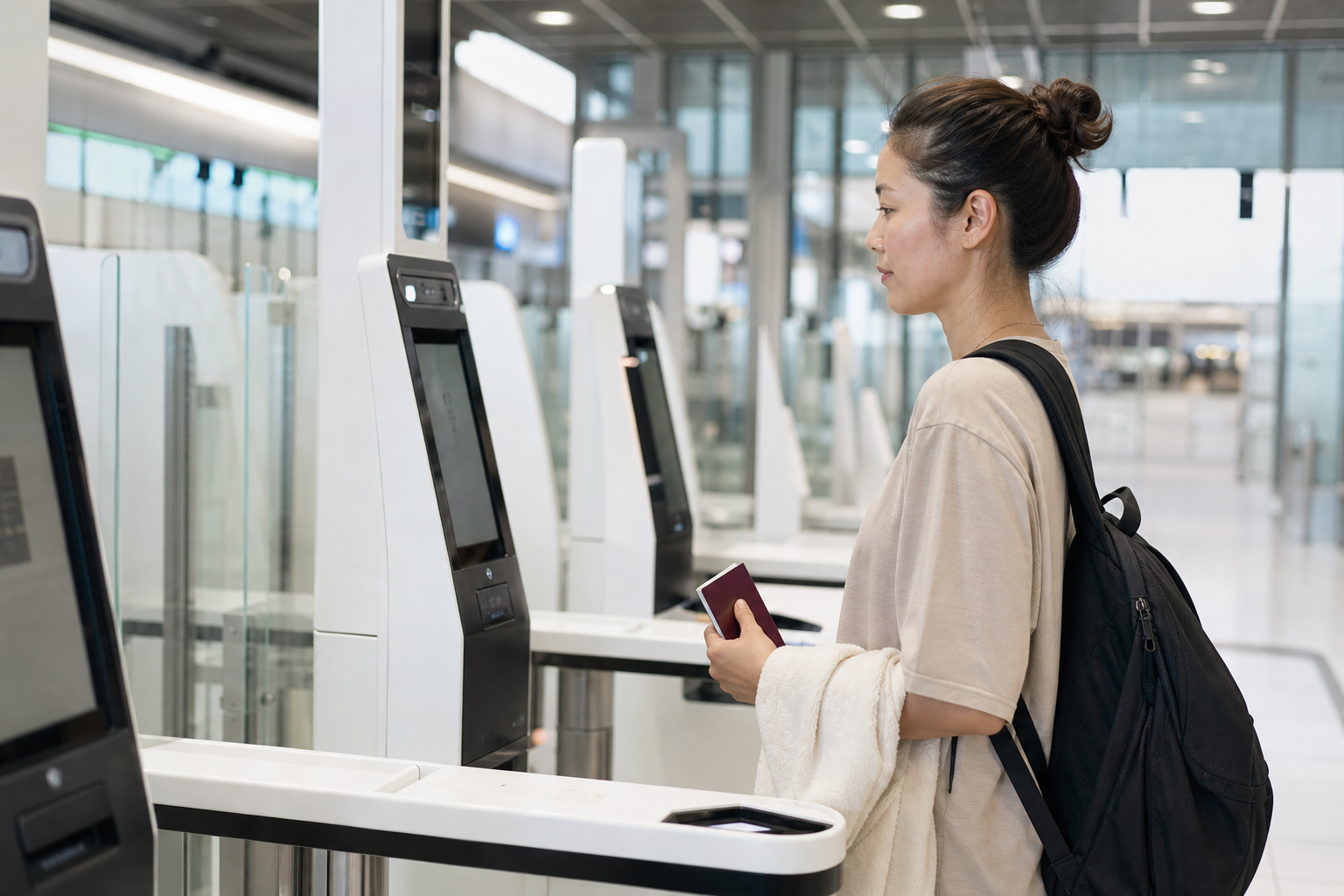
At your first EES-recorded external-border crossing, border authorities may collect your travel-document details, facial image, fingerprints where required, and information relevant to the conditions of entry. The process happens at the border; EES is not a separate visa application to complete before your trip.
Visa-exempt short-stay travellers generally provide a facial image and four fingerprints. Children under 12 do not have fingerprints collected. For short-stay visa holders, fingerprints are normally already held in the Visa Information System, so EES generally records a facial image rather than duplicating those fingerprints.
Refusing to provide required biometric data can result in refusal of entry. On later crossings, authorities can generally verify travellers using their existing facial image and/or fingerprints, although data may be collected again where necessary.
Some border points may offer self-service or automated facilities for eligible travellers with biometric passports. The official Travel to Europe app is also optional, not universal. It can support limited pre-registration functions up to 72 hours before travel in participating locations, but it never replaces the border check. As of the latest official information, functionality varies by country, with Sweden and Portugal supporting different features.
Practical border preparation
- Allow extra time at an external border, especially for your first EES registration.
- Carry your valid passport and, where relevant, your long-stay visa or residence permit.
- Keep supporting travel documents available, such as accommodation, onward-travel, insurance, or proof-of-funds evidence if these are relevant to your entry status.
- Keep your own entry and exit records even though EES is digital.
- Remember that EES does not remove other entry checks. A border officer can still assess whether you meet the conditions for admission.
Use the EES stay checker carefully in 2026
The official EES portal provides a stay-checking tool that can help short-stay travellers estimate whether entry is allowed and how many days may remain. Border officers can also provide information about your remaining authorized stay.
It is useful, but it has an important 2026 transition limitation. The displayed figure does not account for Schengen time that began before April 10, 2026. In addition, through October 6, 2026, an “OK” result can be unreliable for some single- or double-entry visa holders whose earlier permitted entries during the phased rollout were not recorded in EES.
Use the tool as a planning aid, not as a legal guarantee of admission or as a replacement for your own travel log. Entry remains subject to border checks and the officer’s assessment of the relevant conditions.
EES versus ETIAS: two different systems
EES and ETIAS are often mentioned together, but they do different jobs.
- EES is an electronic border-registration system. It affects eligible visa-exempt and visa-required non-EU short-stay travellers and operates at the external border.
- ETIAS is a pre-travel electronic authorization for visa-exempt nationals travelling to the countries it covers. It is not a visa and does not guarantee entry.
As of August 19, 2026, ETIAS is scheduled to begin in the last quarter of 2026, but the European Union has not announced a specific start date. No action is required until the official system launches. When it begins, the stated application fee will be €20 for travellers who are required to pay, and an authorization can be valid for up to three years or until the passport expires, whichever comes first.
Be wary of third-party sites advertising ETIAS registration before the official launch. Check the official EU portal for the confirmed start date and application process.
What happens if you overstay?
EES is designed to identify and record overstays. If you have already used your available 90 days in the relevant rolling 180-day period, you can be refused entry when attempting to return.
An overstay is no longer merely a missing or unclear passport stamp. It can become a digital immigration record with possible consequences for departure, re-entry, and future travel. People found to be staying illegally can be subject to return procedures, and some cases may involve entry bans. Outcomes depend on the facts and applicable law; it is inaccurate to say every overstay automatically creates a five-year ban.
If an apparent overstay resulted from unforeseeable or mitigating circumstances, such as a serious injury requiring hospitalization, official EES guidance indicates that competent authorities may amend the record if credible evidence is provided. Keep documentation and seek prompt, qualified advice if an emergency affects your ability to leave on time.
A practical EES checklist for digital nomads
If you are travelling visa-free or on a short-stay visa
- Treat 90 days as one shared pool across all 29 EES countries.
- Plan for biometric collection at an external border.
- Build extra time into arrival plans, particularly for a first registration.
- Maintain independent evidence of your movements and travel days.
- Do not assume country-hopping or a brief trip outside the EES zone resets your allowance.
- Do not treat visa-free entry as automatic remote-work permission.
If you hold a digital nomad visa or residence document
- Confirm whether it is a qualifying national long-stay visa or residence permit.
- Carry the valid document alongside your passport.
- Check the mobility rules before working or staying in a second country.
- Verify EES treatment carefully if your document was issued by Cyprus or Ireland.
The bottom line
Europe’s Entry/Exit System is not a new route for digital nomads. It is a digital system for recording short-stay travel. For non-EU remote workers travelling on visa-free or short-stay status, the practical effect is clear: the 90/180 rule is still the rule, but there is far less room for vague day counts, lost stamp evidence, or assumptions that moving between countries creates a fresh allowance.
If you want to remain longer or work with clearer immigration status, look at the destination’s own long-stay, residence, remote-work, or digital nomad route—not EES. And wherever you plan to base yourself, verify the latest requirements with the relevant official authority before making travel or work commitments.
Sources & Official Resources
The following sources were checked during the preparation of this article. Requirements and regulations can change, so verify important details directly with the relevant authority before applying or making travel decisions.
- Entry-Exit System – Migration and Home Affairs – European Commission
- FAQs about EES – EES
- What is the EES? – EES
- To whom does the EES not apply? – EES
- FAQs about EES – EES
- Main differences between the EES and ETIAS: What travellers need to know – Migration and Home Affairs
- Entry-Exit System – Migration and Home Affairs – European Commission
- Short-stay calculator – Migration and Home Affairs – European Commission
- Who does what? – Migration and Home Affairs – European Commission
- New rules of issuance of visas (01
- The Entry Exit System is fully operational since 10 April 2026. Who is exempt? – Migration and Home Affairs
- Already in the EU? – Migration and Home Affairs – European Commission
- How will the EES work? What is new during the border checks? – EES
- Data held by the EES – EES
- Check how long you can stay – EES
- Travel to Europe mobile app – EES
- Data held by the EES – EES
- Data held by the EES – EES
- Datos en poder del EES – EES
- Key differences ETIAS and the EES – ETIAS
- European Travel Information and Authorisation System (ETIAS) – ETIAS
- Business Taxation – Taxation and Customs Union – European Commission
- Emergence of unofficial websites – ETIAS