Research checked: August 19, 2026
Slovenia is no longer just a short-stop destination between the Alps, the Adriatic and Central Europe. Since November 21, 2025, it has offered a dedicated temporary residence permit for digital nomads, giving eligible non-EU/EEA remote workers a formal route to spend up to a year in the country.
But choosing Slovenia is only the first decision. Ljubljana offers the broadest range of urban services and the country’s strongest transport connections. Maribor brings a slower second-city rhythm with access to wine country and Pohorje. Koper is the coastal choice, with a Mediterranean setting and Italy close by. Smaller towns can be deeply appealing for focused work and slow travel, but they require more planning around housing, transport and everyday services.
For a wider overview of how these immigration routes differ by country, see Trailandra’s complete guide to digital nomad visas. Slovenia’s route, however, has rules that are important to understand before comparing neighbourhoods or signing a lease.
Slovenia’s digital-nomad permit: the essential facts
Slovenia’s new route is a temporary residence permit for digital nomads, not a digital nomad visa. It is available to foreign nationals who are not citizens of an EU or EEA country and who work remotely using communications technology.
Applicants must be employed by an entity established outside Slovenia, work under a civil-law contract for a foreign entity, or be self-employed abroad. Crucially, they must not enter the Slovenian labour market. The permit removes the usual need for Employment Service consent associated with many work-based residence routes, but that does not mean it authorizes local Slovenian employment or work for Slovenian clients.
- The permit can be issued for the length of the relevant employment or civil-law contract, up to a maximum of one year.
- Foreign self-employed applicants may receive it for one year, or for a shorter intended stay.
- It cannot be extended.
- After it expires, a new digital-nomad application is normally possible only after a six-month break.
- A holder can apply to change to another temporary-residence purpose during the permit’s validity if their circumstances change and they qualify under another route.
The standard application route is through a Slovenian diplomatic mission or consulate abroad. In some cases, people who are already lawfully present in Slovenia may apply in country before their authorised stay ends. Requirements and appointment arrangements can vary by jurisdiction, so confirm the process with the relevant Slovenian consulate or administrative authority before making travel plans.
Income, insurance and address requirements
The law requires adequate health insurance covering at least emergency healthcare in Slovenia, a passport valid for at least three months beyond the intended stay, and sufficient means of subsistence.
The means test is set at twice Slovenia’s average monthly net wage, based on the applicable official wage publication. During Trailandra’s research on August 19, 2026, the latest available net monthly wage figure was €1,680.80 for May 2026. That produced an implied working minimum of approximately €3,362 per month.
This is not a fixed figure. The wage benchmark changes, and applicants should verify the current Official Gazette notice immediately before applying. Do not rely on a figure from a blog post, including this one, as an application-day threshold.
Digital-nomad permit holders may reunite with family members immediately, without a prior-residence waiting period. However, the detailed documents and eligibility rules for individual family members should be confirmed directly with the competent authority.
After arrival, a temporary-residence permit holder must register their temporary residence within eight days of entering Slovenia, receiving the document, or taking up residence. This requires identification and evidence that they can use the address, such as a lease, ownership document or an owner’s written consent.
EU and EEA citizens use a different route
The digital-nomad permit is not for EU/EEA citizens. EU citizens can enter Slovenia with a valid identity card or passport and may stay without registration for the first three months. For a longer stay, they need a residence registration certificate from the relevant administrative unit and must meet the applicable conditions for their basis of residence.
A tax reality check before a one-year stay
A residence permit does not create a blanket Slovenian tax exemption. Slovenia generally taxes tax residents on worldwide income, while non-residents are generally taxed on Slovenian-source income. The Financial Administration of the Republic of Slovenia considers factual ties when assessing residence, including an established residence, family connections and presence exceeding 183 days in a calendar year.
The 183-day figure matters, but it is not the only factor. A foreign employer or foreign client does not, by itself, settle the tax outcome. Treaty rules, the nature of your work, your personal and economic ties, and possible employer-level issues can all matter.
Informational disclaimer: This article is general information, not immigration, legal or tax advice. Before planning a long Slovenian stay, obtain advice from a Slovenian-qualified cross-border tax professional and verify current residence-permit requirements with the relevant official authority.
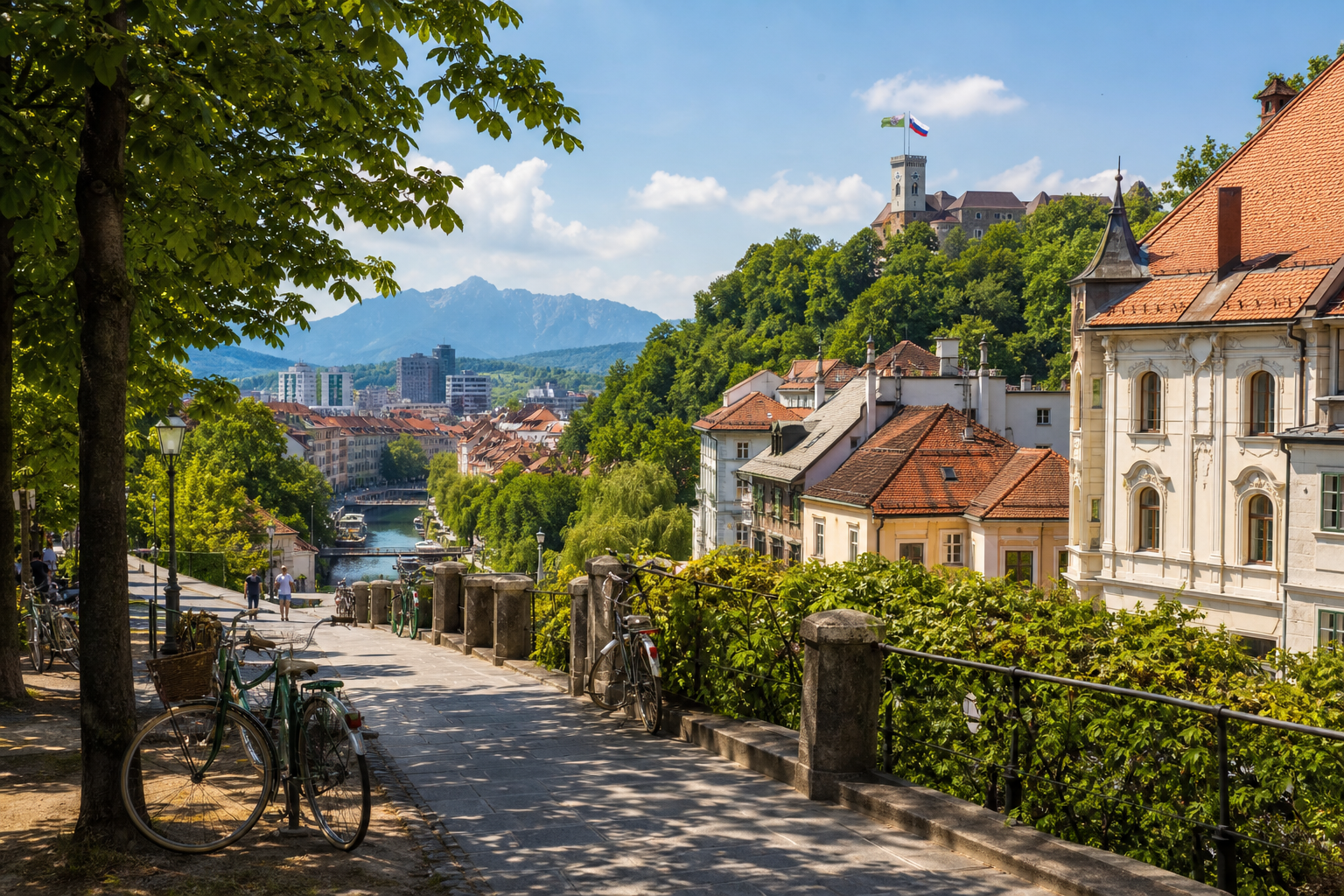
Ljubljana: best for a first Slovenia base
Ljubljana is the sensible default for many first-time nomads. With 298,227 residents in mid-2024, it is substantially larger than Maribor or Koper and functions as Slovenia’s clearest urban centre. It also recorded more than 1.39 million tourist arrivals in 2025, an indication of its depth of accommodation, hospitality and international-facing activity.

Most importantly for long-term remote workers, Ljubljana reduces friction. It is Slovenia’s principal rail and bus hub, making it the easiest base for domestic weekend trips without owning a car. The city also offers the broadest choice of everyday services, restaurants, cultural activity and recurring opportunities to meet people.
Choose Ljubljana if you:
- Are living in Slovenia for the first time and want the easiest landing.
- Value urban convenience, social variety and a more international atmosphere.
- Expect to travel around the country frequently by public transport.
- Want to test Slovenia before committing to a quieter location.
The trade-off is budget uncertainty. There is no standardized official city-by-city long-term rental comparison that supports precise nomad-budget claims. Still, Ljubljana should not be approached as a guaranteed low-cost capital. Slovenia-wide residential prices rose 9.3% year on year in the first quarter of 2026, so check current long-term listings carefully rather than assuming the capital will be inexpensive.
Maribor: best for a slower city-and-outdoors balance
Maribor is Slovenia’s compelling alternative for remote workers who want city basics without capital-city intensity. Its municipality had 113,393 residents in mid-2024: clearly urban, but at a much smaller scale than Ljubljana.
The city’s appeal is more about lifestyle than a simplistic promise of lower costs. Maribor sits on the Drava River, has strong links to wine-country landscapes and gives easy access to the Pohorje area. That makes it a natural fit for people who want regular cycling, hiking or mountain time alongside a conventional city routine.
Choose Maribor if you:
- Want a real city with a calmer, less intense rhythm.
- Prefer wine, river and mountain access to a capital-city environment.
- Are comfortable with a smaller international and professional-networking scene.
- Want rail access while accepting fewer big-city options than Ljubljana.
Maribor should not be marketed as a no-cost alternative to Ljubljana. Existing-flat prices in the city rose 5.5% quarter on quarter in the first quarter of 2026. That is a property-sales measure, not a rental measure, but it is a reminder that affordability needs to be checked through current local housing research.
Koper: best for a coast-first lifestyle
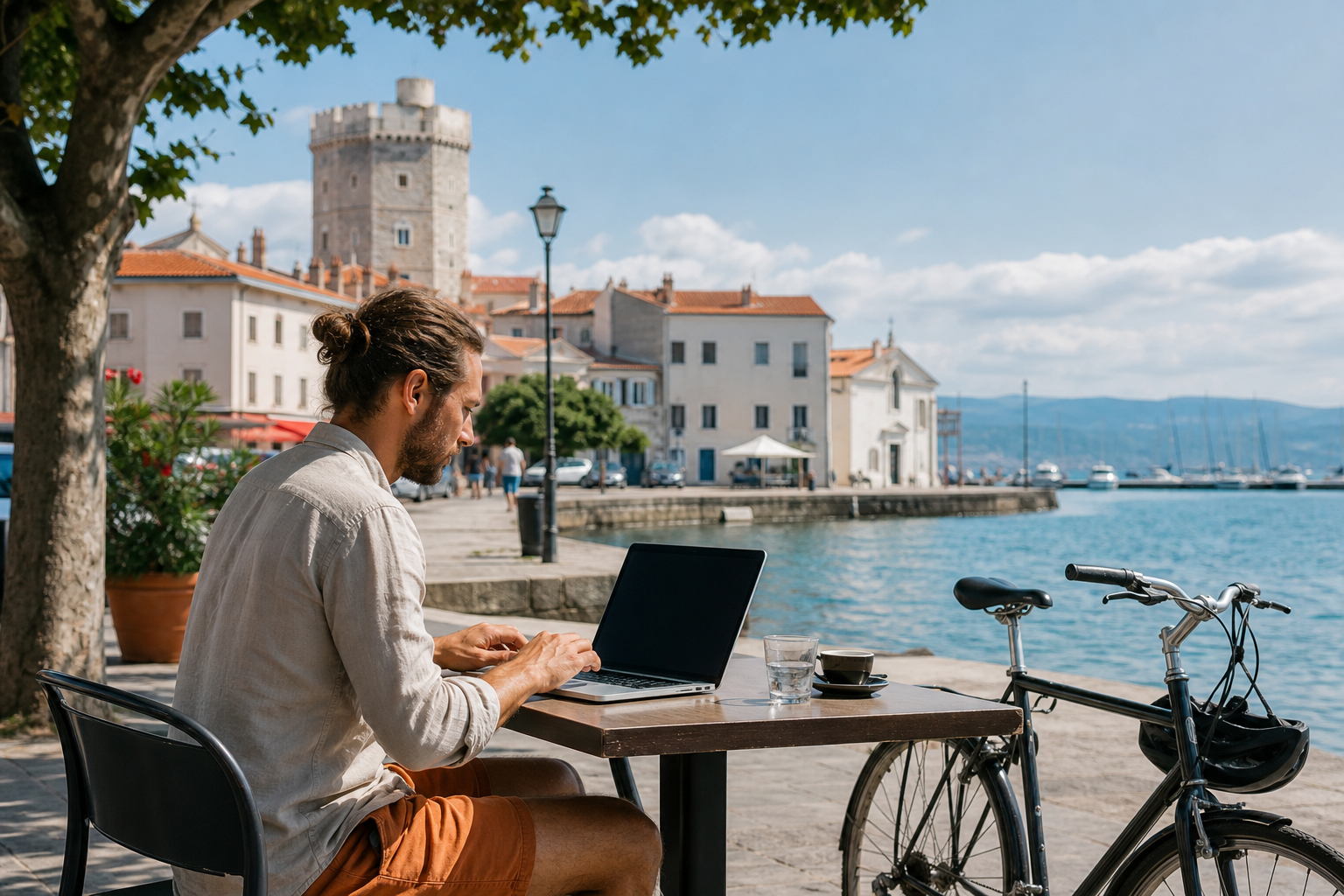
Koper is the right choice when the coast is central to your idea of life in Slovenia. With 54,220 residents in its municipality in mid-2024, it is much smaller than Ljubljana and Maribor, but its Mediterranean and Karst setting gives it a distinct character. The surrounding region combines the Slovenian coast, olive-growing landscapes and easy proximity to Italy.
Koper also has national economic and transport importance through the Divača–Koper rail corridor. However, remote workers should use live timetables for real journey planning rather than relying on project targets for future rail improvements.
Choose Koper if you:
- Would prioritize a seaside setting over the scale of a large city.
- Want Mediterranean character and convenient access to nearby Italy.
- Are happy with a smaller urban ecosystem.
- Can be flexible and proactive when searching for longer-term accommodation.
The main caution is that the research does not support precise claims about Koper’s long-term rents, availability or seasonal premiums. Coastal housing can require more advance planning, especially if you need a particular move-in date, workspace arrangement or registration-friendly lease.
Smaller Slovenian towns: best for intentional slow travel
A smaller town is not one category of experience. Slovenia has historic towns, mountain areas, thermal and spa regions, and coastal communities with very different practical realities. National tourism data show that mountain and seaside resorts attract substantial visitor numbers, reinforcing that Slovenia’s appeal reaches well beyond its three largest urban municipalities.
Places such as Ptuj, Škofja Loka or Novo Mesto may appeal to nomads seeking a more local routine, but the right town depends on the exact lease, transport links and work setup. A quiet base can be highly productive; it can also become inconvenient if you need frequent appointments, backup workspaces or regular travel connections.
Choose a smaller town if you:
- Have an established remote-work routine and do not depend on frequent networking.
- Prefer quiet, outdoors access and a more local pace of life.
- Are willing to investigate transport and practical services town by town.
- Can decide whether a car would materially improve your routine.
Before committing, test the exact location. Check live rail and bus options, confirm that your proposed address can be used for residence registration, ask about reliable internet before signing, and identify practical backups for workdays. Coworking supply, English-language administration and rental inventory may be thinner outside the main cities, although conditions vary widely by town.
How to choose your Slovenian base
- Choose Ljubljana for a first stay, broad services, social options and the most convenient domestic transport base.
- Choose Maribor for a balanced city lifestyle with wine country, the Drava and Pohorje close at hand.
- Choose Koper for coast-first living, Mediterranean character and access to Italy.
- Choose a smaller town for deep work and slow travel, provided you have checked housing, mobility and daily logistics carefully.
Slovenia is best approached as a quality-of-life choice rather than a generic “cheap Europe” destination. The new permit can make a one-year stay possible for eligible non-EU/EEA remote workers with relatively high documented means, but it is non-renewable and does not resolve tax questions. For more destination and immigration planning, browse Trailandra’s digital nomad visa guides.
Whichever base you choose, verify the current income threshold, application channel, insurance wording, tax position, address-registration documents and transport options before you apply or sign a lease. That preparation matters more than choosing the theoretically perfect Slovenian city.
Sources & Official Resources
The following sources were checked during the preparation of this article. Requirements and regulations can change, so verify important details directly with the relevant authority before applying or making travel decisions.
- Temporary residence permit for digital nomads | GOV.SI
- Vsebina Uradnega lista | Uradni list
- Vsebina Uradnega lista | Uradni list
- Earnings of persons in paid employment by legal persons, May 2026
- Entry and residence | GOV.SI
- Entry and residence | GOV.SI
- International taxation | FINANCIAL ADMINISTRATION OF THE REPUBLIC OF SLOVENIA
- International taxation | FINANCIAL ADMINISTRATION OF THE REPUBLIC OF SLOVENIA
- Prebivalstvo – Slovenske regije in občine v številkah
- Tourist arrivals and overnight stays, detailed data, 2025
- Key Projects Division | GOV.SI
- Residential housing price indices, 1st quarter 2026
- HI S TOR IC TO WN S
- Iskalnik voznih redov – Slovenske železnice – Potniški promet
- Koper | TOP coastal vibe and wine routes for you | I feel Slovenia
- Prime Minister Golob: Today we are telling a story about the strength of Slovenian knowledge and expertise | GOV.SI
- Consumer price indices, June 2026